Censuses & surveys
National Population & Housing Census
Counting every person in Papua New Guinea — the 2024 census and the censuses of 1980, 1990, 2000 and 2011.
The National Population and Housing Census counts every person in Papua New Guinea at a point in time. Censuses have been held in 1980, 1990, 2000, 2011 and 2024.
2024 National Population Census
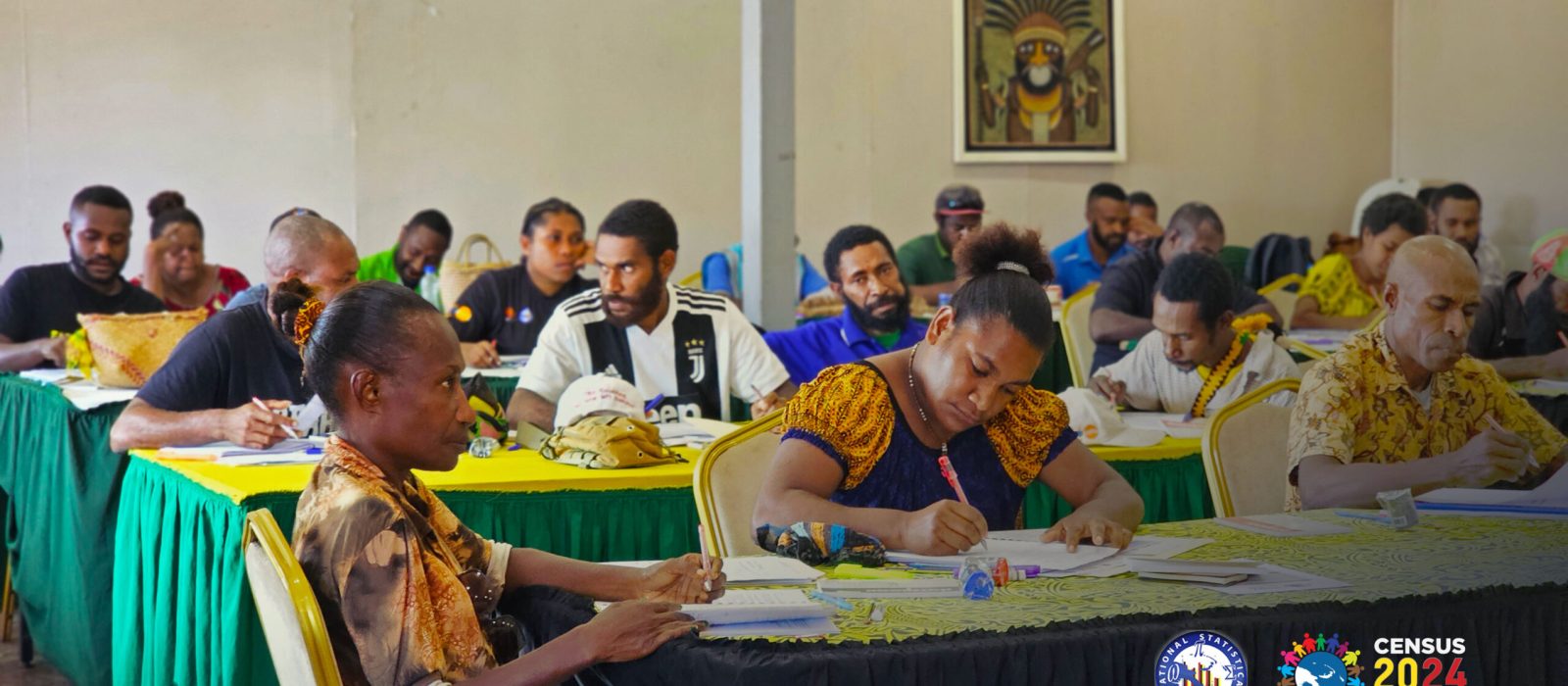
Enumeration for the fifth national census began on 17 July 2024. It was the first PNG census conducted digitally, with field enumerators using tablets (computer-assisted personal interviewing). Final figures were released on 30 October 2025.
10,185,363
Total population, 2024
5,336,546
Males
4,848,817
Females
2.6%
Average annual growth, 2011–2024
The Highlands region is home to 3,634,114 people (36%), Momase 2,753,211 (27%), Southern 2,320,205 (23%) and the Islands 1,477,833 (15%). Morobe (997,545), Eastern Highlands (800,072) and Madang (761,154) are the most populous provinces; the National Capital District has 756,754 residents. Crude population density is 22 persons per square kilometre.
Looking ahead: Census 2030
Preparations for the 2030 National Population and Housing Census are a priority of the National Statistician, with a focus on reaching remote and hard-to-reach communities so that every Papua New Guinean counts.
Previous censuses
The National Population and Housing Census for Papua New Guinea is one of the important national events on the calendar of the country every ten years. The country’s fourth National Population and Housing Census was supposed to be held in July 2010. However, the event was deferred to July 2011 to provide sufficient preparation time. The first three censuses of the country were held in 1980, 1990 and 2000.
Summary of findings [2011]
- The population of Papua New Guinea has reached 7,275,324 according to 2011 Census. It has increased by 40% and at average annual growth rate 3.1% since the last census in 2000. In absolute numbers a total of 2,084,538 persons were added to the population during the last 11 years.
- About 39% of the population live in the Highlands region followed by Momase region with 26% while Southern and Island regions make up 20% and 15% respectively.
- The annual growth for the Papua New Guinea has increased steadily from 2.2 % in 1980 and currently stands at 3.1%. The Highlands and Island regions have annual growth higher than the national average.
- Sex ratio ( number of males to every 100 females) has remained steady at 108 as reported in the last census. Likewise, the household size is 5.3 persons, a slight increase from 5.2 reported in 2000 census.
- Of the 22 provinces, Morobe province alone contains almost 9.3% of the country’s total population, reporting a total population count of 674, 810 person in 2011 Census. Eastern Highlands and the Southern Highlands (minus Hela province) are the other two most populated provinces with population in excess of half a million.
- Significant increase in population is noted mostly for provinces in the Highlands and Islands. However this is not the case for the provinces in Momase region where population growth rate is comparatively lower.
- Since 1980, the population of Papua New Guinea has more than doubled from 3 million to 7.3 million in a matter of 31 years.
Last updated 17 October 2026